← Back
In development Patent pending

How NeuraSole works.

The full version of everything the landing page keeps short: what the two functions are, what the hardware is made of, what our own testing has established — and, just as importantly, what it has not.

If you're on your feet all day

Two functions. One insole.

Whether you're working an 8-hour shift, walking a campus, travelling, or just spending the day upright, NeuraSole is being designed around one idea: support your foot all day, and give you the option to switch on stimulation when discomfort begins. NeuraSole uses transcutaneous electrical nerve stimulation (TENS), a form of electrical stimulation delivered through the skin.

Support

Wears like a normal insole

Cushioned and shaped for everyday foot support. Worn like any other insole, and trims to fit most closed-toe shoes.

Stimulation

Nothing extra to carry

Pads sit beneath the sole of the foot and deliver low-level electrical stimulation, built into the insole itself rather than carried as a separate device.

Control

On only when you choose

Controlled from your phone, and designed for use at rest — seated or standing still, on a break, not mid-stride. Rest is part of the design: a still foot keeps the pads in steady contact with the skin, and the stimulation is intended for the moments after activity, when the muscles and nerves in the foot are already aggravated.

The NeuraSole app showing left and right foot selectors, an off / low / high intensity slider and the battery level app-control.webp The intensity screen.
Intensity. Each foot set independently — off, low or high — with the battery level in the corner.
The NeuraSole app pairing screen, with instructions for connecting each insole and a checkmark on the paired left insole app-pairing.webp The pairing screen.
Pairing. Each insole connects over Bluetooth, one at a time. These are screens from the build we used to run the prototype in testing.

How TENS is understood to work.

TENS is an established form of therapy, and the research describes two effects. Both statements below are about TENS as a category — not measurements of NeuraSole, which we have not yet tested.

Mechanism

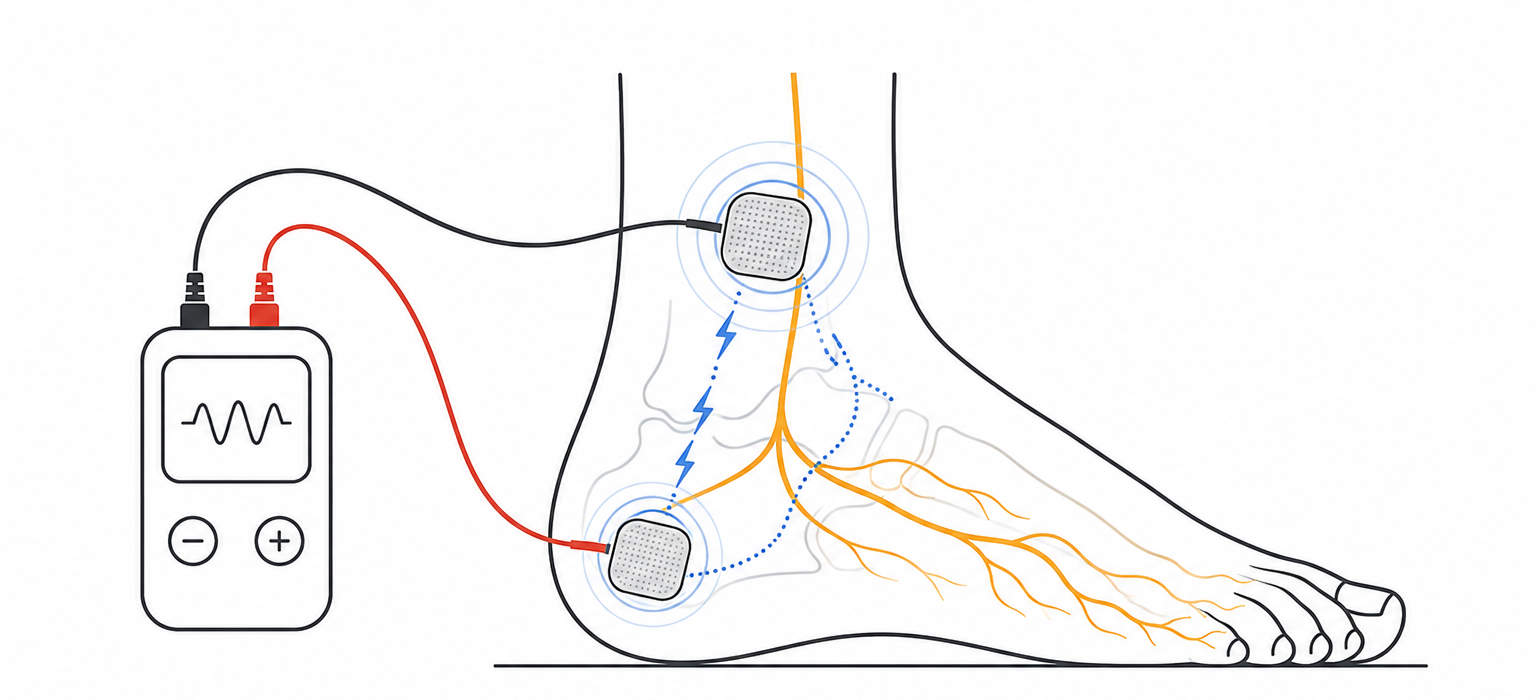
Stimulation is understood to interfere with pain signals on their way to the brain.

Effect

It is also understood to prompt the body to release its own endorphins.

How it normally reaches you

As a handheld controller wired to adhesive patches you position on the skin. That's the part we're changing — the same technique, built into something you already wear, so using it doesn't mean stopping to set up a device.
Status

The stimulation technology is currently being optimized and validated. We can describe what NeuraSole is designed to do, but we have not yet established how well it does it. That testing is the work in front of us — and it's the reason we want to hear from you now rather than after.
See it for yourself

What's inside V1.

The V1 build, coming apart one layer at a time.

Video slot
No video connected yet
Set VIDEO_URL at the top of neurasole.js — paste a YouTube, Vimeo or direct .mp4 link and the player appears here.

Exploded view of the V1 prototype.

Please read

This video shows V1 of the product and is for demonstration only. The prototype is actively being improved — comfort, stability, battery life and the stimulation system are all still changing between iterations. The on/off switch in the video is the V1 control; a proper power button replaces it in V2. Every feature shown is still under development. What you see here illustrates the concept, not the finished product. Nothing shown is available for sale.

Inside the insole.

Support, stimulation and electronics, stacked into something you can wear — assembled, then seen through the shell, then in section under the foot.

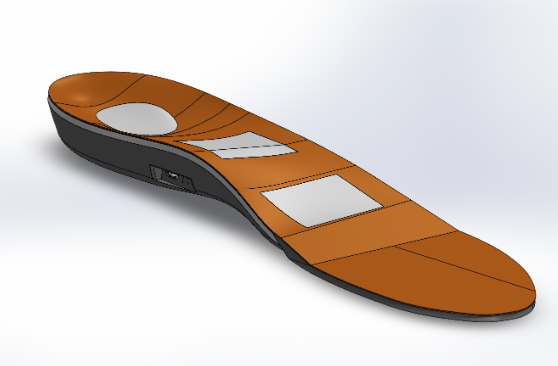
Isometric render of the assembled NeuraSole insole, showing the conductive fabric patches and the side-mounted power button render-assembly.png The isometric render of the assembled insole.
Assembled. Conductive fabric patches at the contact points; the power and Bluetooth button sits on the shell.
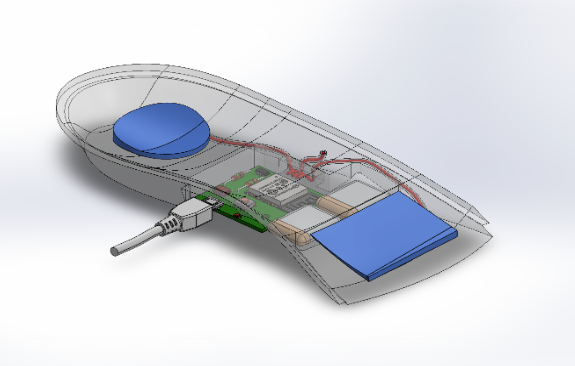
Ghosted render of the insole interior showing the circuit board, wiring harness, two batteries and the charging port render-internals.png The electronics bay, seen through the shell.
The electronics bay. Microcontroller and board, wiring harness, two batteries and the charging port, all under the arch.
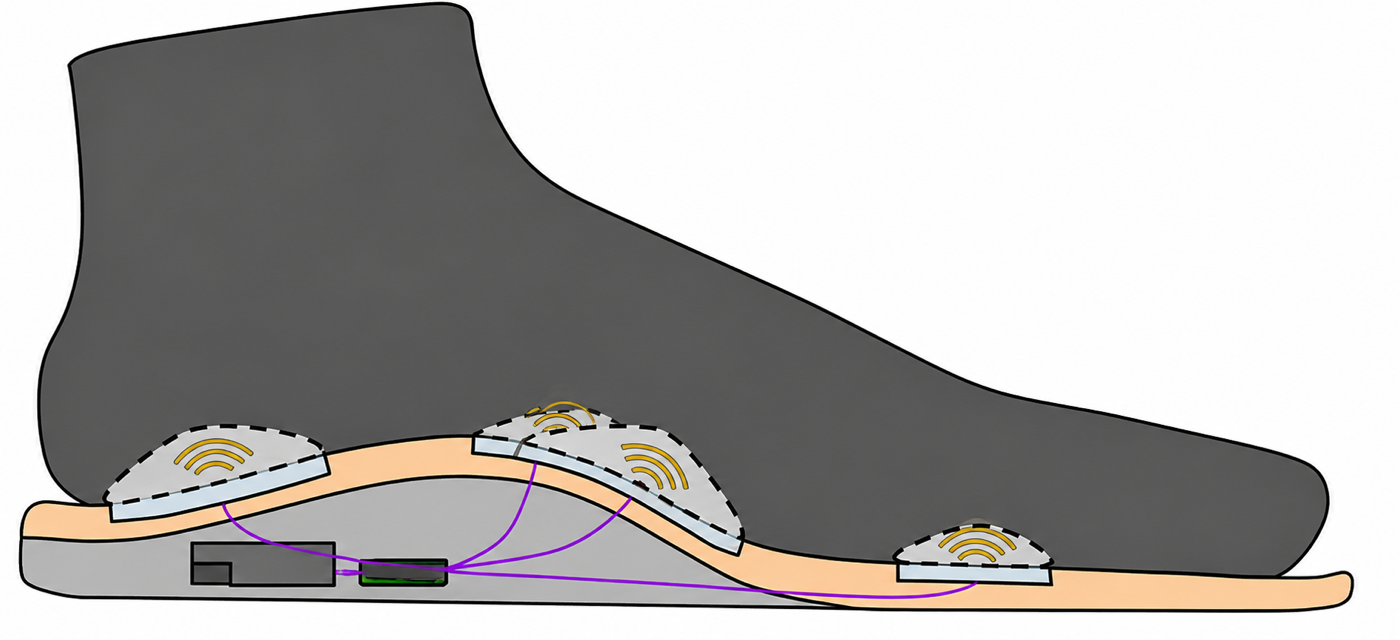
Cross-section diagram of a foot resting on the insole, showing the stimulation points at the heel, arch and forefoot and the wiring running between them render-sideview.png The cross-section through the foot.
Under the foot. Where the stimulation points sit at the heel, arch and forefoot, seen in section.

What we've proven so far

What we have actually measured.

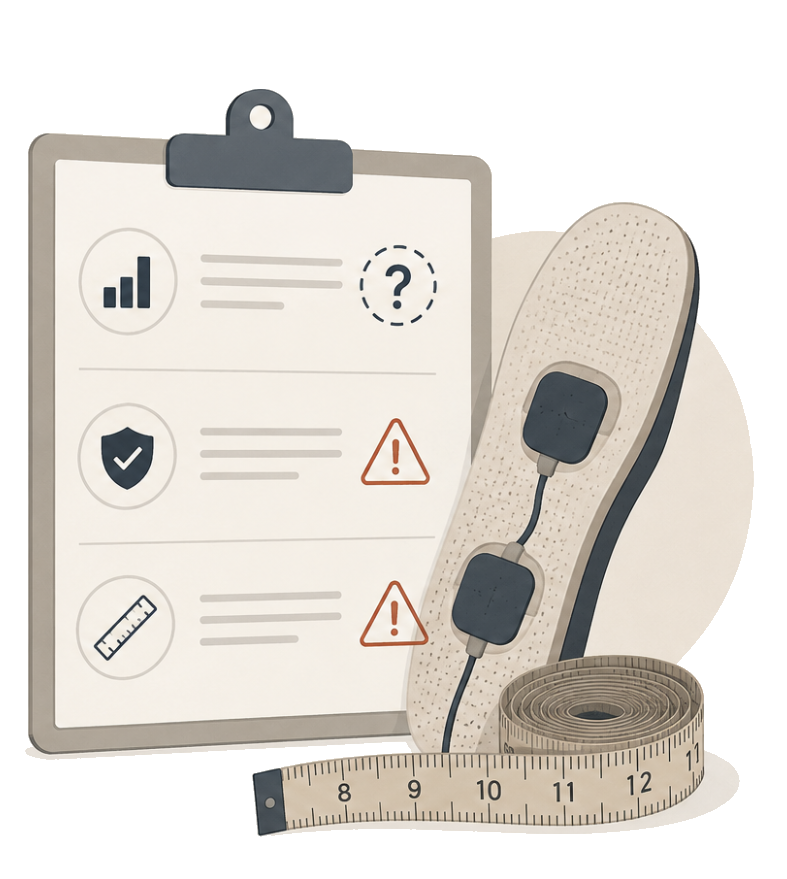
Three prototypes have been designed, built and tested in our own lab. These are the results that came out of that work. They are bench results — measurements of how the hardware is built and how it holds up under load and wear.

3
Prototypes built and tested in our own lab
250 lbper insole
Held in bench testing with no material failure — and your weight is split across two
8+ hrs
Worn continuously in our comfort testing
~5 hrs
Stimulation on a single charge, measured in our testing
M8–M12W9.5–W13.5
US shoe sizes it fits today
Support
Contoured support shell under a foam insole and cushion layer
Stimulation
TENS through pads and conductive fabric patches at the contact points
Power
Two LiPo batteries and a charging port, sealed under an electronics lid
Control
Bluetooth to a phone app, plus a power button on the shell
Sizing
A cuttable trim guideline to fit most closed-toe shoes

Engineering and durability results from our own bench testing: they describe how the hardware is built and holds up, not symptom relief or clinical benefit.

Being straight with you

What we haven't established.

A page like this usually only tells you the good part. Here is the other half, so you can judge the product on what it actually is today.

Whether it eases discomfort, and by how much

No clinical testing has been completed. Every description of relief on this site is a statement of intended design, not a measured result.

Regulatory status

NeuraSole has not been cleared or approved by the FDA. It is not for sale, and nothing on this site is an offer to sell.

Fit outside the current size range

The current prototype fits US men's 8–12 (women's 9.5–13.5). Sizes outside that range haven't been built yet.

Before you consider using one

Electrical stimulation isn't for everyone.

Whatever device it comes from, stimulation delivered through the skin carries real contraindications. Do not use a device like this without speaking to a clinician first if you have a pacemaker, another implanted electronic device or a metal implant, if you have epilepsy, if you are pregnant, or over skin with an active infection or an open wound.

One more thing, straight from the podiatrist we consulted during development: devices like this are a companion to the conservative care that already works — bracing and physical therapy — never a replacement for it. That is how NeuraSole is designed to be used.

Nothing on this site is medical advice, and nothing here is a substitute for seeing someone. Persistent foot pain is worth taking to a qualified healthcare professional.

Want to follow the development?

The early access list is where the next prototype gets shown first.

Join the early access list →